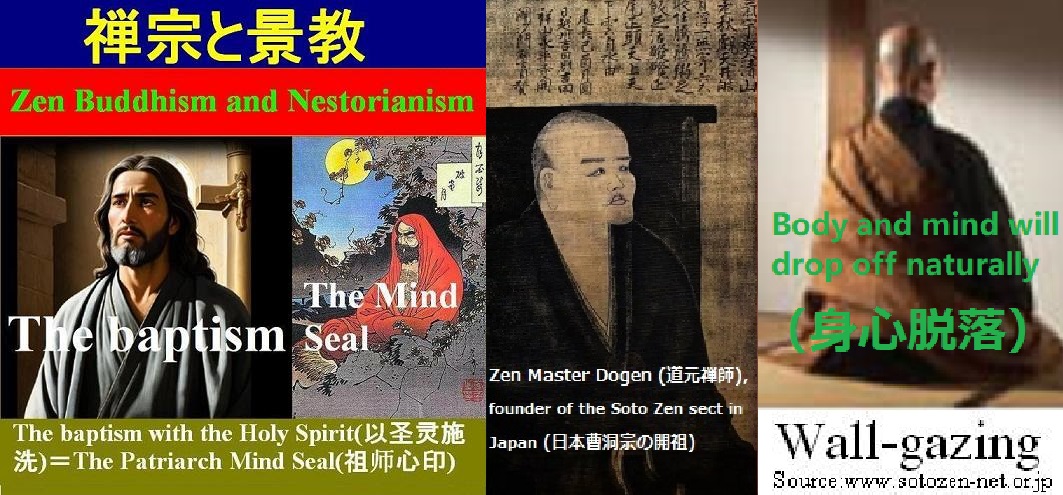
Zen Buddhism and Nestorianism Series 23:Body and mind will drop off naturally
<◆Zen Buddhism and Nestorianism Series 24:The myriad things return to one>
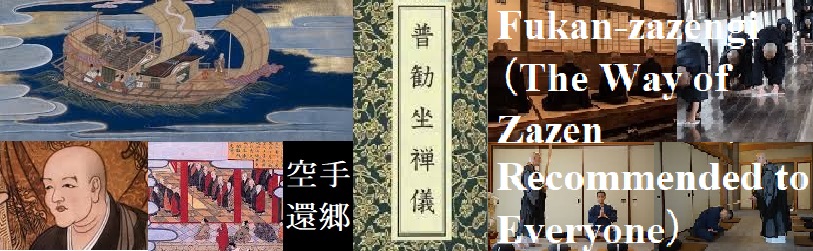
“Cease studying words and following letters. Learn to withdraw, turning the light inwards, illuminating the Self. (Doing so), your body and mind will drop off naturally, and original-Self will become manifest. If you wish to attain suchness, practice suchness immediately.”(普勧坐禅儀:The Way of Zazen Recommended to Everyone)
This time, let's take a look at Zen Master Dogen's path to enlightenment, "Dropping off body and mind."
The origins of Zen Master Dogen and the reasons for his ordination
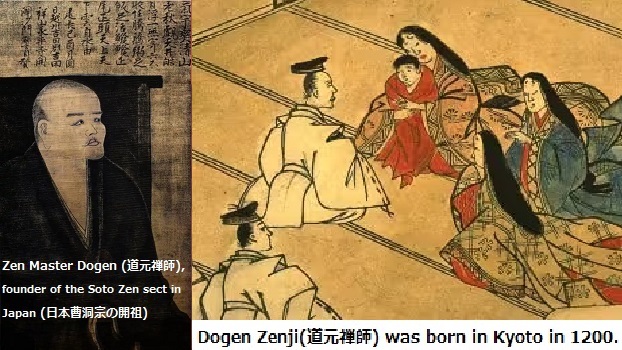
Born in Kyoto in 1200 to Minister of the Interior Koga Michichika(久我通親) and the daughter of Regent and Chancellor Fujiwara no Motofusa(藤原基房), Dogen(道元), the founder of the Japanese Sōtō sect(曹洞宗), was of a distinguished family, descended from the Murakami Genji (Koga clan), the ninth generation descendant of Emperor Murakami(村上). However, after losing his father at the age of two and his mother at the age of eight, Dogen felt a sense of impermanence and ascended to Mount Hiei(比叡山) at the age of 12, shaved his head, and became a monk.
Seeking Buddhist teachings in Song Dynasty of China
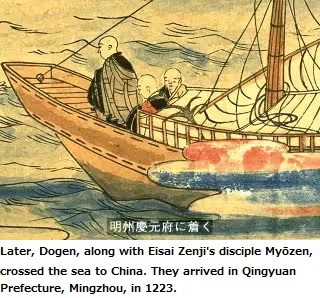
While training on Mount Hiei, Dogen was troubled by the many questions he had about Buddhism that he was unable to find answers to. At the urging of the Tendai Buddhist monk Koin(公胤1145-1216), Dogen decided to travel to Song China with Myozen(明全1184-1225), a disciple of Eisai(栄西), the founder of the Rinzai sect of Buddhism in Japan.
An encounter with an old temple cook
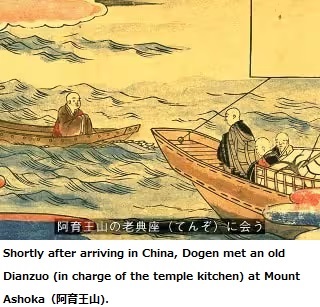
Dogen, who met an old monk being in charge of the cooking manager(典座) of the Ashoka Temple(阿育王寺) on a merchant ship docked in Qingyuan Prefecture, Mingzhou (now Ningbo City), was told, "You foreigners do not understand ascetic practice(弁道) and do not know the characters(文字)." Dogen felt deeply embarrassed, and when he met the old man again, he asked him again, "What is ascetic practice(弁道)?" The old monk replied, "Ascetic practice is life itself, it is the limit of the ten directions, there is no escaping or hiding, it is right in front of you." Dogen then asked again, "What are characters?" The old monk loudly recited, "One, two, three, four, five."
Meeting a True Master
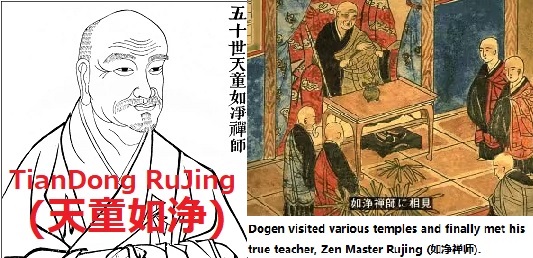
Dogen traveled throughout China seeking Buddhist teachings at various monasteries, finally meeting his true teacher, Zen Master Rujing.
Zen Master Rujing said to Dogen, "From now on, you may come to the abbot's quarters to ask questions, day or night, dressed in your traditional robes. I am like a father to you, so please forgive my rudeness." Zen Master Rujing patiently and meticulously gave Dogen his earnest teachings on various questions about Buddhism.
"Kushugenkyo" and "Fukukan Zazengi"
In the autumn of 1227, Dogen asked Master Rujing for leave to complete his training, left Mount Tendo, and Kushugenkyo(空手還郷returned to Japan empty-handed), carrying only Myozen(明全)'s remains. For the first two or three years, he lived at Kennin-ji Temple(建仁寺) in Kyoto, and during this time he wrote "Fukan Zazengi(普勧坐禅儀)," which can be considered a manifesto for the founding of the Soto Zen sect in Japan.
The Founding of "Kosho-ji Temple" and "Shobogenzo"
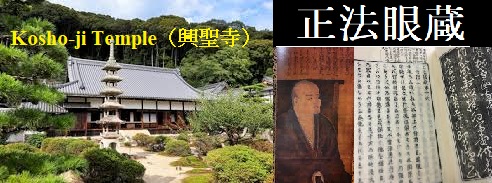
Dogen retired to Fukakusa in 1230 and wrote the "Bendo-wa(辦道話)." In the spring of 1233, he founded Kosho-ji Temple(興聖寺) in Fukakusa. Beginning in the fall of the same year, he composed and lectured on various volumes of the Shobogenzo(正法眼蔵), including the "Genjo Koan(現成公案)." In 1234, Koun Ejo (孤雲懐奘1198-1280) became his disciple. Ejo served as Dogen's attendant until his death and wrote the "Shobogenzo Zuimonki(正法眼蔵随聞記)." In 1236, Dogen established Japan's first monk's hall(僧堂) at Kosho-ji Temple and began full-scale training of monks. However, in 1243, Kosho-ji Temple was destroyed by monks from Mount Hiei.
Founding of Eiheiji Temple
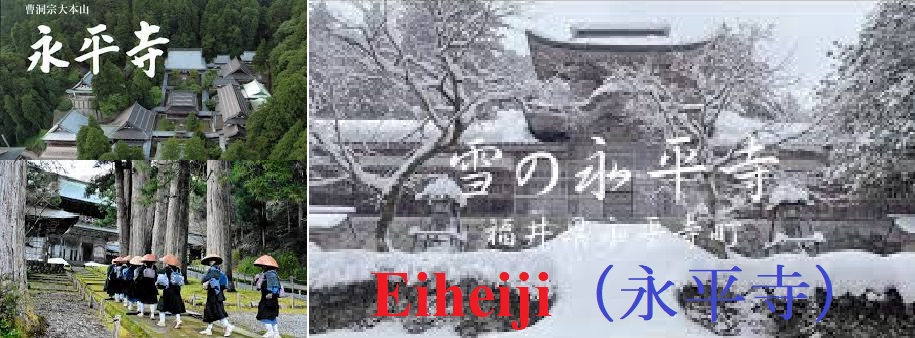
In July 1243, at the request of lay believer Hatano Yoshishige(波多野義重), he moved to Echizen(越前), commuting between Kippo-ji Temple (吉峰寺Robaiyama, Eiheiji-cho, Fukui Prefecture) and Yamasibu-dera (禅師峰寺, Ono-gun, Fukui Prefecture), where he composed and preached over 20 volumes of the Shobogenzo(正法眼蔵). In 1244, he built Daibutsu-ji Temple(大仏寺), which was renamed Eiheiji(永平寺) in 1246. The following year, in 1247, he traveled to Kamakura(鎌倉) at the invitation of regent Hojo Tokiyori(北条時頼), who offered to donate temple land to him, but he firmly declined.
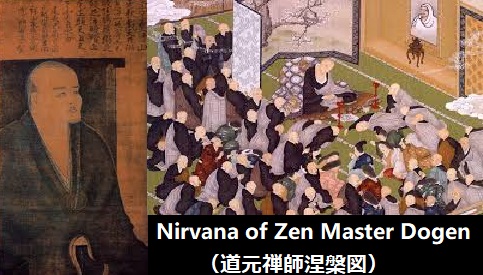
Passing Away
After presenting the final chapter of the Shobogenzo, "The Eight Great Enlightenments(八大人覚)," Dogen's illness worsened. In 1253, he traveled to Kyoto for recuperation. He passed away on August 28 of that year at the private home of his lay disciple, Kakunen(覚念). He was 54 years old.
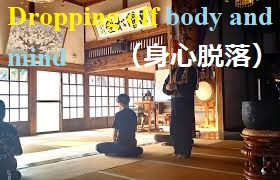
Dropping off body and mind
Dogen Zenji, the founder of the Japanese Soto Zen School (曹洞宗) went to Song China and studied under Zen Master Rujing at Tiantong-si Temple. After returning to Japan, he established the sect's style of "shikantaza," which is based on the principle of "dropping off body and mind."
One early morning in the first year of the Baoqing era (宝慶元年1225), near the end of the "Xiaanju (夏安居)", one monk began to doze off during zazen(坐禅). Rujing scolded him, saying, "Meditation should involve dropping off body and mind. What can you do if you just fall asleep?"
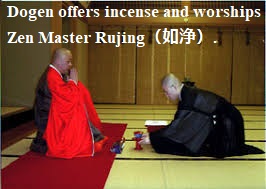
Dogen, who was meditating nearby, heard the words "dropping off body and mind" and suddenly had a great enlightenment. He immediately went up to his teacher's chambers to offer incense and worship.
When Rujing asked, "Why do you burn incense?", Dogen replied, "I have come dropping off body and mind."
When Rujing tried to approve Dogen's enlightenment by saying, "Body and mind dropping off, dropping off body and mind," Dogen rebuked him, saying, "This is a temporary skill, so you should not arbitrarily give your seal of approval to me." When Rujing said, "I will not seal you without reason," Dogen further asked for confirmation, "What dose it mean for not sealing me without reason?" Rujing then replied, "Drop off, drop off," and fully acknowledged Dogen's enlightenment.
A attendant named Guangping, who was nearby and listening to this, exclaimed in admiration, "This is no trivial matter. A foreigner has achieved such a great feat."《Kenzeiki(建撕記)》
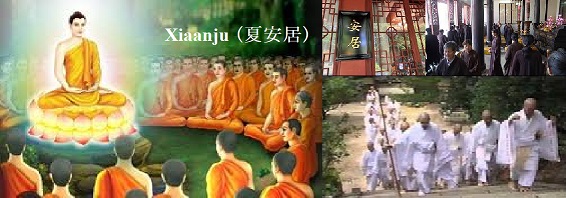
Xiaanju (夏安居)
In Zen Buddhism, the 90 days during the rainy season from April 16th to July 15th on the lunar calendar are called "Xiaanju (夏安居)" in Chinese or "Geango" in Japanese," during which monks practice and meditate en masse in monk's hall(僧堂)for training. It's not surprising that some drowsiness may occur. Usually, an unsui(雲水) carrying a keisaku (警策a stick) circles the hall at appropriate times, so if you wait with your hands clasped together as he passes in front of or behind you, he will tap you on the neck or shoulders with the keisaku to dispel your drowsiness.
However, this method may not have existed at the time Dogen traveled to Song China. A monk began to doze off beside Dogen. When Master Rujing saw this, he shouted, "Meditation should involve dropping off body and mind. What can you do if you just fall asleep?"
The Essence of Dogen Zen
These words, "body and mind drop off," were like a bolt from the blue, and cleared away Dogen's long-standing doubts. Dogen realized that when body and mind drop off, the self and the universe merge, and a state of “Heaven, earth, and I have the same root and myriad things and I are one body,” is realized. He immediately went to Rujing's abbot's chambers to offer incense and worship. At this moment, the pedagogical method and formula of “Dogen Zen (道元禅)”, with its core principle of "shikantaza(只管打坐)," was established.
It is easy to see why Rujing's attendant exclaimed, "This is no trivial matter. A foreigner has achieved such a great feat." Dogen was 25 years old at the time, and Rujing 63.
Different hearsay
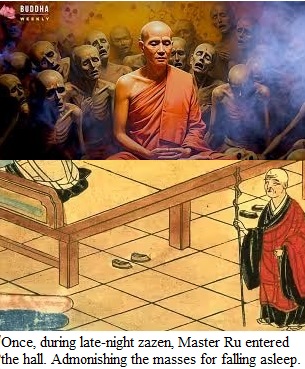
The above story of Dogen's enlightenment is based on Kenzeiki(建撕記), a biography of Dogen compiled by the 14th abbot of Eiheiji(永平寺), Kenzei(建撕). However, sources such as Shobogenzo Zuimonki(正法眼蔵随聞記), Hokei-ki(宝慶記), and Denkoroku(伝光録) state, "Once, during late-night zazen, Master Ru entered the hall. Admonishing the masses for falling asleep, he said, 'Meditation should involve dropping off body and mind. He sits in a daza(打坐) without offering incense, worshiping, chanting Amitabha, repenting, or reciting sutras. Dogen heard what the master had to say, and suddenly attained enlightenment, and this became his connection. After meeting Master Ru, he practiced day and night,' and so on, which suggests this event occurred during 'late-night zazen,' rather than during the 'Dawn Zazen of Xiaanju (夏安居).'
"Goyazazen(後夜坐禅)" is also called "Yaza(夜坐)" and is considered a very important event that takes place late at night to conclude the day, but when Zen Master Rujing looked around the monks' hall(僧堂), it seemed that almost everyone, except for Dogen, was dozing off.
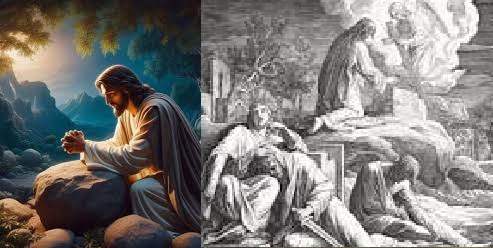
This is reminiscent of the scene on the eve of his crucifixion when Jesus returned from his final prayer in Gethsemane to find all twelve apostles (except Judas Iscariot) fast asleep.
It is said that Zen Master Rujing was furious, as he beat one of them badly with his sandals and went back to his abbot's quarters.
When Dogen saw this scene, he immediately went to Rujing's abbot's chambers, where Rujing, still angry, questioned him, asking, "What have you come for?" When Dogen silently offered incense and bowed, Rujing retorted, "Why are you offering incense?" To which Dogen replied, "I have come dropping off body and mind," to which Rujing grinned and muttered, "Drop off, drop off."
【Thesis】"A man can possess eternal life through accepting testimony of the Son of man and being baptized by him." (John 5:24)
【Anti-thesis】But "The one who comes from the earth cannot accept the testimony by one from heaven."(John 3:32)
How then can a man possess eternal life?
【Synthesis】"If you want to be baptized with the Holy Spirit, you can just go back to the word which was with God in the beginning (John 1:1) and certify that God is truthful. (John 3:33)"
When he said, "You are Huichao," Zen Master Fayan thrusted vivid Self in Huichao in front of his eyes.