Zen Buddhism and Nestorianism Series 26:Just refrain choosing
<◆Zen Buddhism and Nestorianism Series 26:Just refrain choosing>
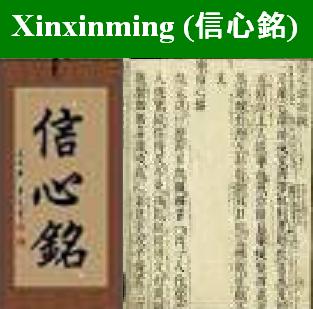
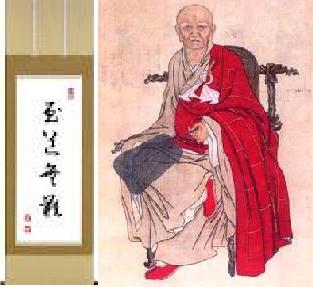
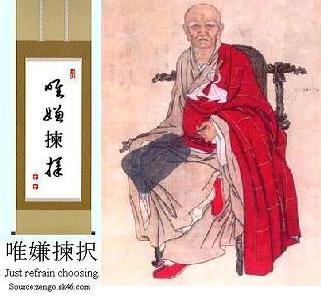
During the later period of the Tang Dynasty in China, a monk asked Zen master Zhaozhou Congshen, "The third patriarch Jianzhi Sengcan said in his book 《Xinxinming (Inscribed on the Believing Mind)》, 'The supreme Way is not difficult; it simply dislikes choosing.' What is non-choosing?" ZhaoZhou said, "Holy am I alone throughout heaven and earth."
This time, let's take a look at the koan from "The Blue Cliff Record, Cases 57-59: The supreme Way is not difficult; it simply dislikes choosing"
In order for God's work to be revealed
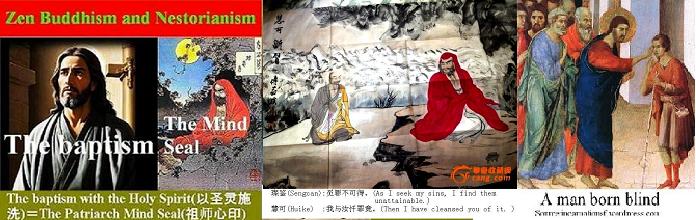
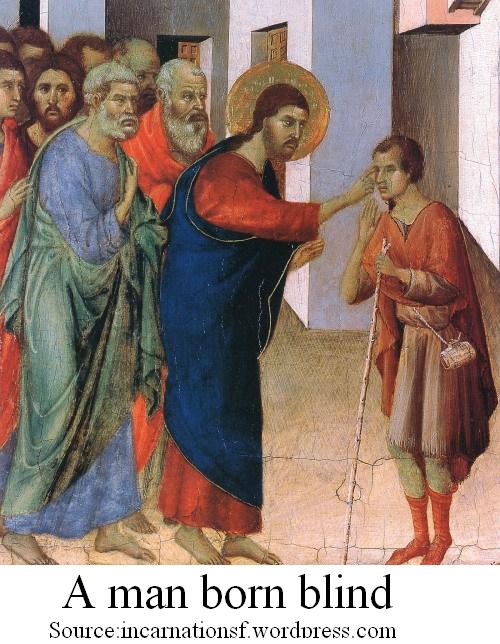
As Jesus was walking along, he saw a man who had been blind from birth. "Rabbi," his disciples asked him, "why was this man born blind? Was it because of his own sins or his parents' sins?" "It was not because of his sins or his parents' sins," Jesus answered. "This happened so the power of God could be seen in him." (John 9:1-3)
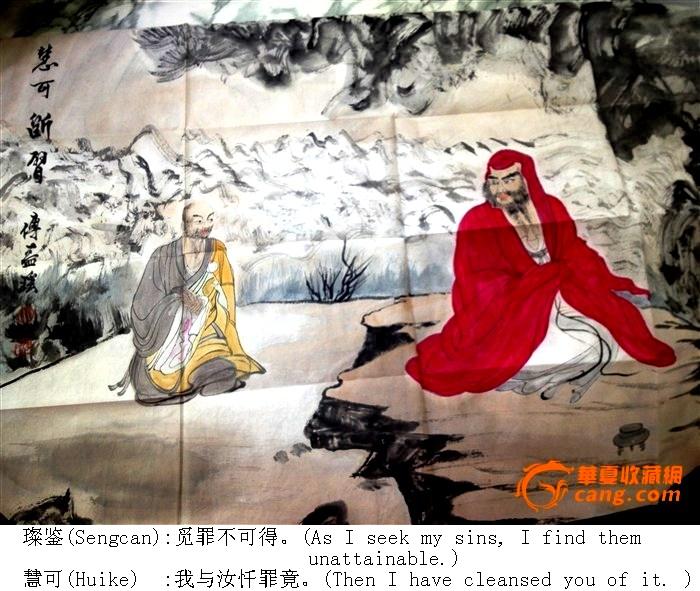
As I seek my sins, I find them unattainable.
Time passed to the end of Wei, Jin, and Southern and Northern Dynasties period (220-589 CE) of China, Jianzhi Sengcan chanshi (?-606), who is known as the Third Chinese Patriarch of Zen Buddhism but was still a layman of forty troubled with leprosy at that time, heard that there was a priest of high virtue learned Zen Buddhism originated in India.
He immediately went for instruction to the priest, that is, the second patriarch Huike and asked, "I am riddled with leprosy; please absolve me of my sin."
Huike said, "Bring me your sin and I will cleanse you of it."
Sengcan thought for awhile; then said, "As I seek my sins, I find them unattainable."
Huike replied, "Then I have cleansed you of it. You should live by the Buddha, the Dharma, and Samgha (Brotherhood = monk), and abide therein."
Sengcan asked Huike: "I can see you are a monk, what are the Buddha and the Dharma?"
Replied the master: "This mind is Buddha, this mind is the Dharma; the Dharma and the Buddha are not separate. This is also true of the Samgha."
This satisfied Sengcan, who now said, "Today for the first time I have realized that the essence of sin is not inside, not outside, not in between. So it is also of mind. Buddha and the Dharma are not separate either."
Huike saw that Sengcan's understanding is profound, he shaved his head and said: "This is my treasure. I name him Sengcan (Jewel of Samgha)."
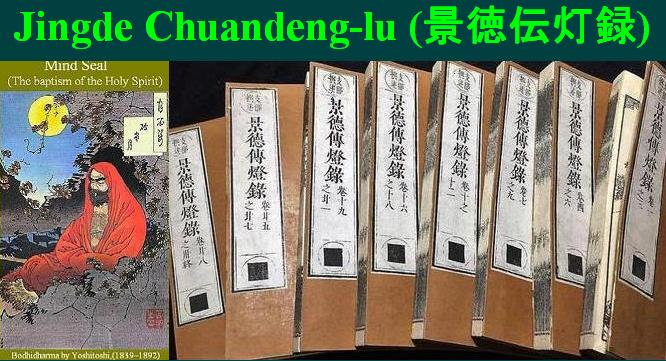
Then Sengcan devoted to the Buddha, the Dharma, and Samgha under Huike's guidance and he was gradually cured of his illness. (ChuanTengLu, Part 3)
Persecution of the Three Wu and One Zong
Incidentally, it is said that the third patriarch, Sengcan(僧璨), met the second patriarch, Huike(慧可), in the second year of the Tianping(天平) era of the Eastern Wei(東魏) dynasty (535 AD), received the full precepts at Guangfu Temple(光福寺) that same year, became a disciple of Huike, and then served the first patriarch, Bodhidharma(菩提達磨), together with the second patriarch, Huike, for a little over two years.
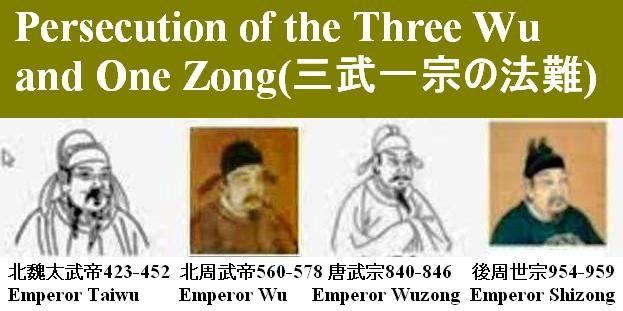
However, under the anti-Buddhist policies of Emperor Taiwu(太武帝) of Northern Wei(北魏), Emperor Wu(武帝) of Northern Zhou(北周), Emperor Wuzong(武宗) of Tang(唐) and Emperor Shizong(世宗) of Later Zhou(後周) —the so-called "Persecution of the Three Wu and One Zong(三武一宗法難)"—Zen Buddhism in China, from its founder Bodhidharma to its fourth patriarch Daoxin, seems to have been in a state of near-total disrepair.
In the 12th year of the Kaihuang era of the Sui Dynasty (隋開皇12年:592AD), 14-year-old novice Daoxin(道信) became a disciple of the third patriarch Sengcan. The following year, in the 13th year of the Kaihuang era (593AD), the second patriarch Huike passed away. The fourth patriarch Daoxin is said to have been almost the only disciple of the third patriarch Sengcan.
After returning to Mount Wankong(皖公山) in Shuzhou(舒州), present-day Qianshan City(潜山市), Anqing City(安慶市), Anhui Province(安徽省), from his lecture tour on Mount Luofu(羅浮山), Boluo County(博羅県), Huizhou City(恵州市), Guangdong Province(広東省), the third patriarch, Zen Master Sengcan, passed away in the second year of the Daye(大業) era of Emperor Yang of the Sui Dynasty (隋煬帝), 606 AD, and was posthumously given the title of Zen Master Jianzhi(鑒智禅師) by Emperor Xuanzong(玄宗皇帝) of the Tang Dynasty.
On his deathbed, Zen Master Sengcan said, "Many people pass away while sitting in the lotus position, but the way we face life and death is a matter of personal choice. I will continue walking today," and he placed his hand on a large tree and passed away while standing.
(The Further Biographies of Eminent Monks:続高僧伝)
Realization of the Kingdom of God
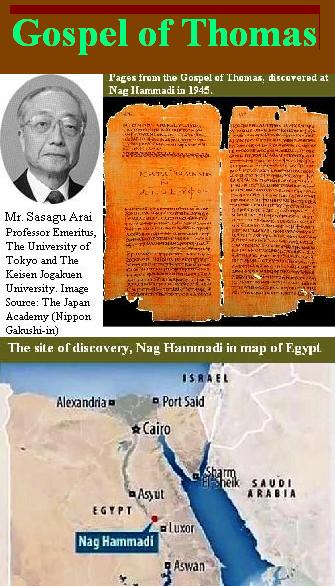
In the Gospel of Thomas, Jesus said, "Let one who seeks not stop seeking until finds. When one finds, one will be troubled. When one is troubled, one will marvel and will reign over all."(Gospel of Thomas, Verse 2)
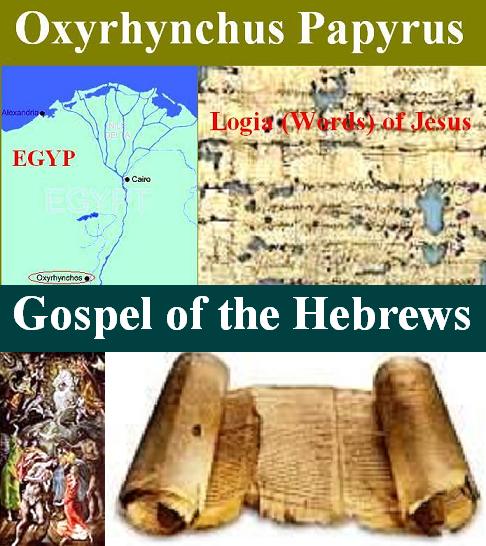
According to Mr. Sasagu Arai(荒井献), author of the Japanese edition of the Gospel of Thomas, the above-mentioned "Gospel of Thomas, Verse 2" has similar parallel passages in both the "Oxyrhincus Papyrus 654 (OP654)," a fragment of the Greek-written "Logia (Words) of Jesus" papyrus discovered in Oxyrhincus, Egypt between 1897 and 1904, and the "Gospel of the Hebrews."
--- ---
OP654:
Let one who seeks not stop seeking until finds. When one finds, one will be shaken. When one is shaken, one will rule. When one rules, one will be at a sabbath.
The Gospel of the Hebrews:
Let one who seeks not stop seeking until finds. But those who find will be shaken. When one is shaken will rule. When one rules, one will be at a sabbath.
--- ---
The flow of the three sentences can be summarized as follows:
--- ---
Gospel of Thomas:
'To seek' → 'To find' → 'To be shaken' → 'To be amazed' → 'To rule over all things'
According to Mr. Sasagu Arai, the Gospel of Thomas replaces the word "rest" in OP654 and the Gospel of the Hebrews with "rule over all things," and also emphasizes the necessity of "seeking."
The goal of "seeking" is to "rule over all things," and "rule over all things" is synonymous with "kingly rule" = "the Kingdom," and for Thomas, "the Kingdom" ultimately means "human beings' inherent self-control."
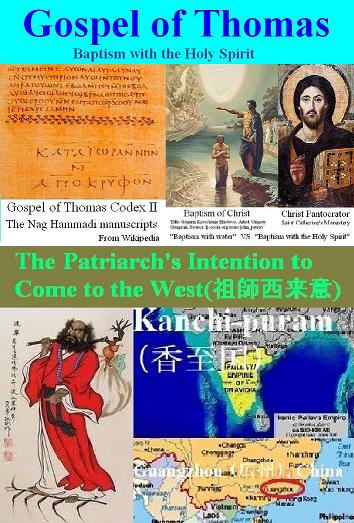
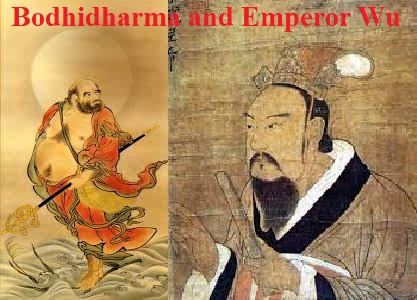
In other words, for Jesus in the Gospel of Thomas, the role of the Messiah was to realize the "manifestation of the Kingdom" and, ultimately, the "true self-governance of humanity," and it seems that "The Patriarch(Bodhidharma)'s Intention to Come to the West" also lies somewhere along these lines.
The Way is simpl. Just refrain choosing.
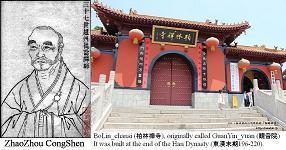
One day a monk asked Zhaozhou Congshen (778-897), one of the great Chan (Zen) masters during the later period of the Tang Dynasty in China, served as the abbot of a temple called Guanyin-yuan, "The third patriarch Jianzhi Sengcan chanshi said in his book 《Xinxinming (Inscribed on the Believing Mind)》, 'The supreme Way is not difficult; it simply dislikes choosing.' What is non-choosing?"
ZhaoZhou said, "Holy am I alone throughout heaven and earth."
The monk said, "That is still choosing."
ZhaoZhou howled out, "You stupid bumpkin, where is the choosing?"
The monk remained silent.
Isn't that the hideout of Zen Buddhists?
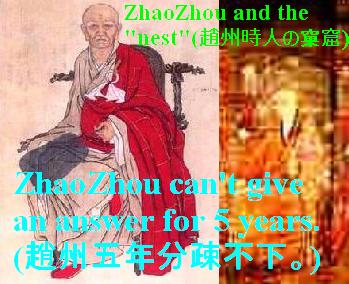
However, another monk who had been listening to their discussion interjected, "'The supreme Way is not difficult; it simply dislikes choosing.' Isn't that the hideout of Zen Buddhists? Just as birds flying in the sky need nests to rest their wings."
Then, Master Zhaozhou gave a rather solemn reply, saying, "Once someone asked me like that. I am sorry that even after five years I still can't give an answer to it."
Then, the other monk asked ZhaoZhou, "'The supreme way is not difficult, it simply dislikes choosing. But even if a word is uttered, it is already an action of 'choosing.' -- Then how can you, Master, try to lead other people?"
ZhaoZhou said, "Why don't you quote the sentence to the end? There are lower phrases saying, 'Just do not hate or love, and it will be thoroughly clear.' and so, aren't there?"
The monk said, "Sorry, I just read until this part."
ZhaoZhou said, "Oh is that so." And he muttered, "It's only: 'The supreme way is not difficult; it simply dislikes choosing.'"
【thesis】 "A man can possess eternal life through accepting testimony of the Son of man and being baptized by him." (John 5:24)
【anti-thesis】 But "The one who comes from the earth cannot accept the testimony by one from heaven."(John 3:32)
How then can a man possess eternal life?
【synthesis】 "If you want to be baptized with the Holy Spirit, you can just go back to the word which was with God in the beginning (John 1:1) and certify that God is truthful. (John 3:33)"
When he said, "You are Huichao," Zen Master Fayan thrusted vivid Self in Huichao in front of his eyes. (The Origin of Christianity P.171)
The thirtieth patriarch Jianzhi Sengcan went for instruction to the twenty-ninth patriarch Huike and asked, "I am riddled with sickness (said to be leprosy); please absolve me of my sin."
Huike said, "Bring me your sin and I will absolve you."
Sengcan thought for awhile; then said, "As I seek my sins, I find them unattainable."
Huike replied, "I have absolved you. You should live by the Buddha, the Dharma, and Samgha (Brotherhood), and abide therein."
Sengcan asked Huike: "I can see you are a monk, a member of the Buddhist community; what are the Buddha and the Dharma?"
Replied the master: "This mind is Buddha, this mind is the Dharma; the Dharma and the Buddha are not separate. This is also true of the Samgha."
This satisfied Sengcan, who now said, "Today for the first time I have realized that the essence of sin is not inside, not outside, not in between. So it is also of mind. Buddha and the Dharma are not separate either."
Huike saw that Sengcan's understanding is profound, he shaved his head and said: This is my treasure. I name him Sengcan (Jewel of Samgha). (The rest is omitted.)
《Xinxinming》
The Ultimate Way is without difficulty; it's only averse to discrimination:
Just do not hate or love, and it will be thoroughly clear.
A hairsbreadth's miss is as the distance between sky and earth.
If you want to have it appear before you, don't keep conforming and opposing.
Opposition and conformity struggling become a sickness in the mind.
If you don't know the hidden truth, you work in vain at quieting thought.
It is complete as space itself, without lack or excess. (Translator, unknown: The rest is omitted.)
《The Blue Cliff Record》Case 57: ZhaoZhou's 'The supreme Way is not difficult'
A monk asked ZhaoZhou, "'The supreme Way is not difficult; it simply dislikes choosing.' What is non-choosing?"
ZhaoZhou said, "Holy am I alone throughout heaven and earth."
The monk said, "That is still choosing."
ZhaoZhou said, "You stupid bumpkin, where is the choosing?"
The monk remained silent.
《The Blue Cliff Record》Case 58: ZhaoZhou and the "nest"
A monk asked ZhaoZhou, "'The supreme Way is not difficult; it simply dislikes choosing.' Isn't that the nest of the people of our time?"
ZhaoZhou said, "Once someone asked me like that. I am sorry that even after five years I still can't give an answer to it."
《The Blue Cliff Record》Case 59: ZhaoZhou's "simply dislikes choosing"
A monk asked ZhaoZhou, "'The supreme way is not difficult, it simply dislikes choosing.' But even if a word is uttered, it is already an action of 'choosing.' -- Then how can you, Master, try to lead other people?"
ZhaoZhou said, "Why don't you quote the sentence to the end?"
The monk said, "Sorry, I just read until this part."
ZhaoZhou said, "It's only: 'The supreme way is not difficult; it simply dislikes choosing.'"