Oak tree in the garden
Zhaozhou's spirit
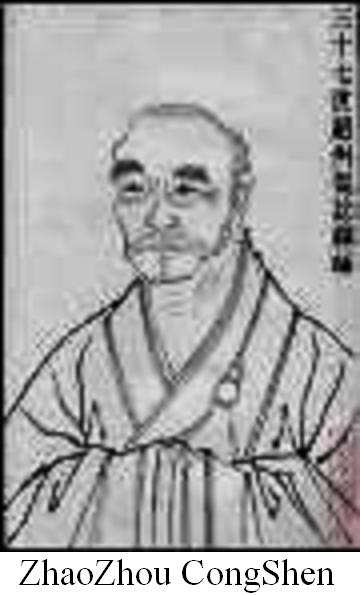
Zhaozhou Congshen (778-897), one of the great Chan (Zen) masters during the later period of the Tang Dynasty in China, served as the abbot of a temple called Guanyin-yuan, located in a small town of Hubei. One day a monk asked Zhaozhou, “With what intention did Bodhidharma come to China?” Zhaozhou answered, “The oak tree in the front garden." (Wumenguan CASE 37)
Wumen's Comments: If you grasp the full meaning of Zhaozhou’s answer you will understand that, there is no Shakyamuni Buddha before you and no Maitreya Buddha after you.
Five small barley loaves and two small fish
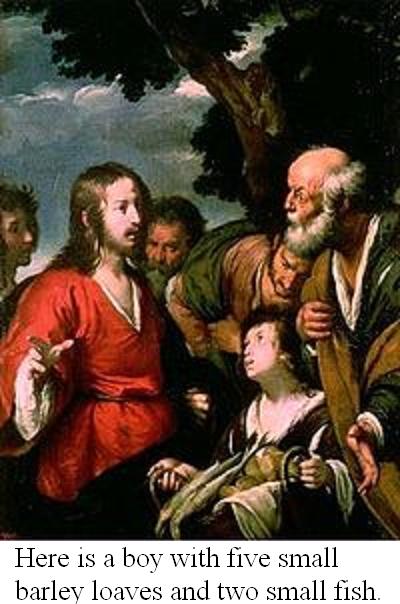
Jesus crossed to the far shore of the Sea of Galilee and went up a mountainside and sat down with his disciples. When Jesus saw a great crowd following him, he asked his disciples to give them bread as he always did. But Andrew, Simon Peter's brother, spoke up, “Here is a boy with five small barley loaves and two small fish, but how far will they go among so many?”
Jesus said, “Have the people sit down.” There was plenty of grass in that place, and the men sat down, about five thousand of them. Jesus did not complain about how little bread and fish they had, but just took the loaves, gave thanks, and distributed to those who were seated as much as they wanted. He did the same with the fish. When they had all had enough to eat, he said to his disciples, “Gather the pieces that are left over. Let nothing be wasted.” So they gathered them and filled twelve baskets with the pieces of the five barley loaves left over by those who had eaten. (John 6:1-13)
If they did not have even one loaf of bread and a fish, what would Jesus have done? He would have said to the people "God wants us to be hungry, so let us share the hunger" and would have given thanks.
Food that endures to eternal life
The next day when Jesus, who had returned to Capernaum, went to the synagogue and saw some of the people who had followed him from the opposite side of the Sea of Galilee where they had eaten the loaves. He said "I tell you the truth, you are looking for me, not because you saw miraculous signs but because you ate the loaves and had your fill. Do not work for food that spoils, but for food that endures to eternal life." (John 6:22-27)
Then they asked him, “What must we do to do the works God requires?” just as the monk asked Zhaozhou the reason of Bodhidharma's visiting China.
Jesus gave a similar answer to Zhaozhou, “Believe in me who has been sent to you by God.”(John 6:28-29)
However they were not satisfied and asked, “What miraculous sign then will you give that we may see it and believe you? What will you do? Our forefathers ate the manna in the desert; as it is written: 'He gave them bread from heaven to eat.'"
Jesus replied, “I am the living bread which my Father has given to you. Only one who eats my flesh and drinks my blood has eternal life.’” (John 6:30-58)
Without the Spirit, the flesh counts for nothing
On hearing it, many of his disciples said, “This is a hard teaching. Who can accept it?” From this time many of his disciples turned back and no longer followed him, according to the Gospel of John. Aware that his disciples were grumbling about this, Jesus said to them, “Does this offend you? What if you see the Son of Man ascend to where he was before! The words I have spoken to you are spirit and they are life. The Spirit gives life; without the Spirit, the flesh counts for nothing.” (John 6:60-63)
Jesus' teaching is "Spirit". If someone is unable to obtain ‘Spirit’, it means nothing for him to eat Jesus’ flesh and to drink his blood. In other words if anyone has already received ‘Spirit’, whatever he eats and drinks, is Jesus’ flesh and blood. Therefore Jesus asked his disciples "Gather the pieces that are left over. Let nothing be wasted."
The scene of the Last Supper, where Jesus ate the Passover with his disciples is seen in the Gospel of Matthew chapter 26. While they were eating, Jesus took bread, gave thanks, broke it and gave it to his disciples, saying, “Take and eat; this is my body.” Then he took the cup, gave thanks and offered it to them, saying, “Drink from it, all of you. This is my blood.” (Mat 26:26-28) Then Jesus went with his disciples to a place called Gethsemane and fell with his face to the ground and prayed, “My Father, if it is possible, may this cup be taken from me. Yet not as I will, but as you will.” (Mat26:36-39)
The hardship happens so the power of God could be seen
There are the rich, the honored, the talented and also the blind and lame in this world. It is not an equal world. However there is one thing we can be sure of and that is that all are sent by God with the Divine Mandate.
As Jesus was walking along, he saw a man who had been blind from birth. “Rabbi,” his disciples asked him, “why was this man born blind? Was it because of his own sins or his parents' sins?” “It was not because of his sins or his parents' sins,” Jesus answered. “This happened so the power of God could be seen in him.”(John 9:1-3)
Jesus taught us that we had to give thanks and accept God's arrangements for us. The Divine Mandate cannot be altered. These arrangements are the starting point to do the will of him who sent us and to finish his work. (Eko-an Hensho-koji 2008/03/23)
What is "Baptism with The Holy Spirit"?
According to the dialectic of the Gospel of John,
【thesis】 "A man can possess eternal life through accepting testimony of the Son of man and being baptized by him." (John 5:24)
【anti-thesis】 But "The one who comes from the earth cannot accept the testimony by one from heaven."(John 3:32)
How then can a man possess eternal life?
【synthesis】 "If you want to be baptized with the Holy Spirit, you can just go back to the word which was with God in the beginning (John 1:1) and certify that God is truthful. (John 3:33)"
When he said, "You are Huichao," Zen Master Fayan thrusted vivid Self in Huichao in front of his eyes. (The Origin of Christianity P.171)
Purchase here
[Reference]
The Gateless Gate, Case 37
A monk asked Zhaozhou, "With what intention did Bodhidharma come to China?"
Zhaozhou said, "The oak tree in the front garden."
Wumen's Comments:
If you grasp Zhaozhou's spirit in his answer precisely, there is no Shakyamuni Buddha before you and no Maitreya Buddha after you.
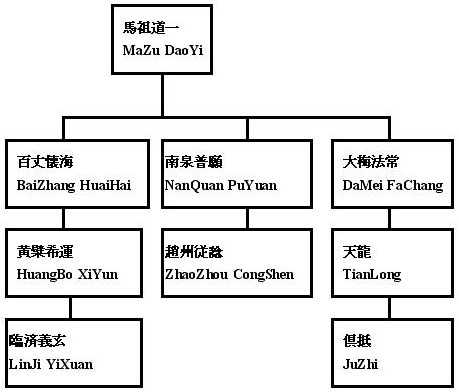
Zhaozhou Congshen 's genealogy
Your Comments / Unsubscribe
SEAnewsFacebook
SEAnewsGoogle
SEAnews eBookstore(Google)